
Reading a Repair Estimate: What Every Line Item Actually Covers

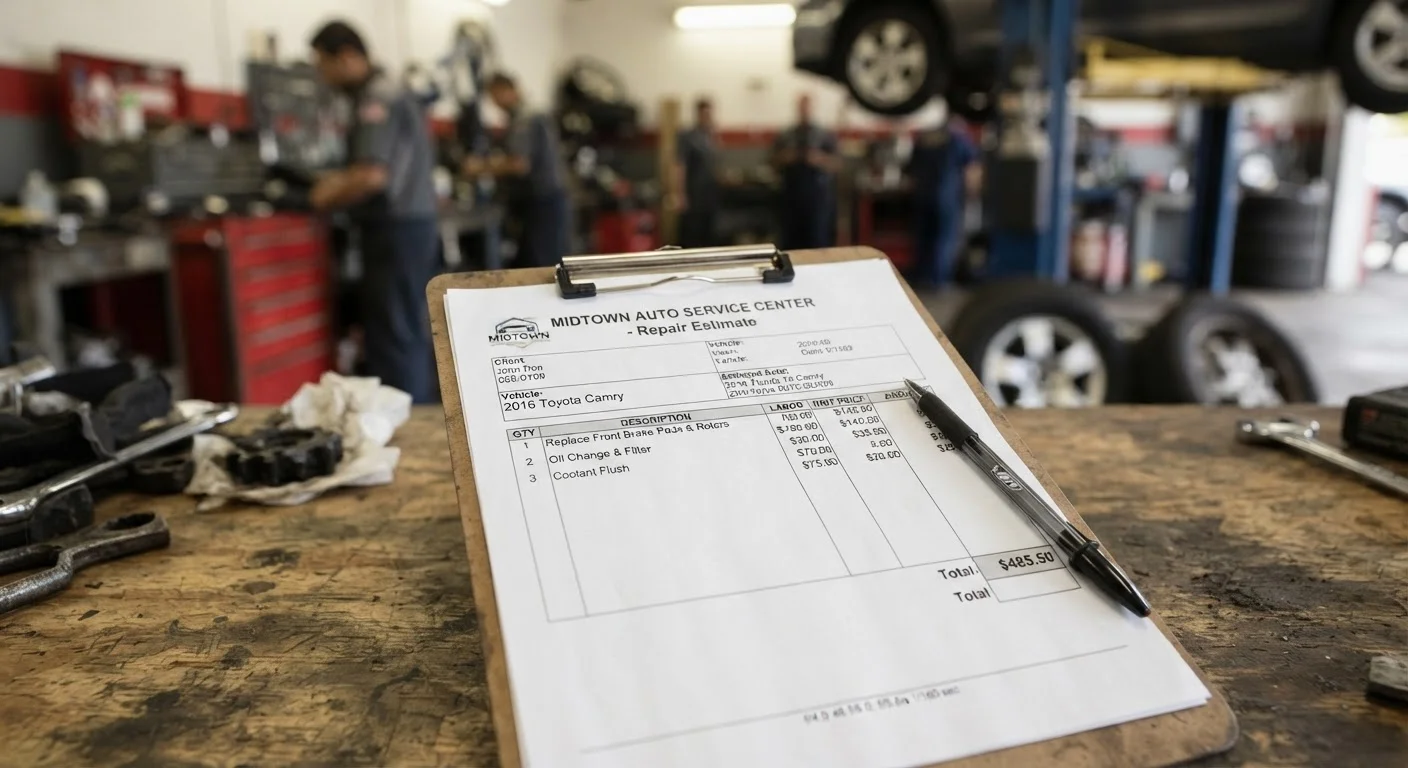
Photo: primesearches.net editorial
Key Takeaways
- Labor hours on an estimate come from industry time guides, not a stopwatch on your specific car.
- Parts can carry a markup of 25 to 100 percent over wholesale cost; asking for OEM versus aftermarket options gives you leverage.
- Shop supply fees and hazardous waste disposal charges are real costs, but their amounts are negotiable.
- You have the legal right in most states to request your old parts back after the repair.
- Getting a second estimate on jobs over $500 is a straightforward way to verify whether pricing is reasonable.
Why repair estimates confuse most car owners
A repair estimate looks like a simple document until you try to read it closely. Three or four line items can represent completely different cost structures, each with its own markup logic. Understanding those structures does not require mechanical knowledge; it requires knowing what questions to ask before you sign.
If you want a broader picture of how repair costs fit into what you spend on a vehicle each month, see our article on why your car costs more than it should. This guide focuses specifically on dissecting the estimate itself, line by line.
What you will need
What each section of the estimate actually means
Most estimates follow a standard format with three cost categories: labor, parts, and fees. Each works differently.
Labor charges
Shops bill labor using a flat-rate system. That means they look up a repair in a published time guide (produced by data companies that track average repair times across many shops) and charge you for that number of hours regardless of how long the job actually takes. A transmission fluid service might be listed as 0.8 hours. If the technician finishes in 25 minutes, you still pay for 0.8 hours. If it takes an hour, you also pay for 0.8 hours.
The shop's labor rate per hour, typically shown at the top of the estimate, can range from roughly $80 to over $180 depending on whether you are at a dealership, a franchise chain, or an independent shop. Dealerships generally charge more. Flat-rate hours multiplied by the shop's hourly rate gives you the labor subtotal.
Parts charges
Shops buy parts at a wholesale cost and sell them to you at a marked-up retail price. A markup of 25 to 50 percent is common; some shops go higher on specialty items. The estimate should list each part by name and part number. If it only says "brake hardware" without a number, ask for specifics.
You can also ask whether the part is OEM (original equipment manufacturer, meaning it matches factory specifications) or aftermarket (produced by a third party). Aftermarket parts are often less expensive and perfectly adequate for many repairs, but they vary in quality. Knowing which tasks are straightforward can also tell you whether a part is something you could supply yourself, though shops may decline to install customer-supplied parts or may not warranty that portion of the work.
Shop fees
Lines labeled "shop supplies," "environmental fee," or "hazardous waste disposal" cover consumables (rags, brake cleaner, lubricants) and regulated disposal of used oil or coolant. These fees are legitimate, but they are sometimes applied as a flat percentage of the labor total rather than an actual cost calculation. A fee of 5 to 10 percent of labor is typical; anything above that is worth questioning.
How to review an estimate before you approve work
The steps below walk through a review you can do in about 15 minutes, either in the waiting room or before you drop off the vehicle. Preparing before your service visit puts you in a better position to have this conversation.
Confirm the estimate is written and itemized
Most states require shops to provide a written estimate before beginning work above a certain dollar threshold (commonly $100 to $150, though the exact amount varies by state). If a shop hands you only a total with no breakdown, ask for a line-item version. A written estimate is your legal protection if the final bill comes in higher than authorized.
Check the labor hours against published guides
Flat-rate time guides are commercially available online. Search for the repair name and your vehicle's year, make, and model to find the typical labor hours listed. If the shop's estimate shows significantly more hours than the published range, ask how they arrived at that figure. Reasonable explanations include vehicle-specific complications or prior damage that adds time.
Verify each part number and its source
Write down or photograph the part numbers from the estimate. Look them up on the manufacturer's website or parts retailer sites to get a sense of retail pricing. The shop's price will be higher, but if it is more than double the retail price you find, that is worth discussing. Also confirm whether each part is OEM or aftermarket so you can make an informed choice.
Question any line items without a clear description
Every fee on the estimate should have a plain-language explanation. Ask the service writer to describe, in one sentence, what each vague line item covers. If the answer is unsatisfying or changes between conversations, that is a reason to pause before authorizing.
Ask about your right to the old parts
In most states, you can request that replaced parts be returned to you after the repair. This lets you verify the work was actually done. Make the request in writing before the repair begins, because some parts (such as cores with a deposit or items sent to a rebuilder) may not be returnable under all circumstances. The service writer should be able to tell you which parts qualify.
When a second opinion makes financial sense
Any repair quoted above $500 is worth a phone call to at least one other shop. You do not need a full second inspection, just a ballpark labor quote for the same job using the same description. If the second shop's number is more than 20 percent lower, it is reasonable to go back to the first shop with that information and ask whether there is flexibility.
Dealership service departments often price higher than independent shops on routine repairs, though they may be preferable for complex electronic or warranty-adjacent work. The trade-off between cost and familiarity with your specific model is a judgment call based on the repair type.
Managing repair costs is one part of broader vehicle ownership costs. See what car ownership actually costs and how to manage those costs on a tight budget for more context.
This article is for general informational purposes only. Repair costs, labor rates, and consumer rights vary by location. Verify your state's specific consumer protection rules regarding written estimates and parts return with your state attorney general's office or a local consumer protection agency.
The content provided on our blog site traverses numerous categories, offering readers valuable and practical information. Readers can use the editorial team’s research and data to gain more insights into their topics of interest. However, they are requested not to treat the articles as conclusive. The website team cannot be held responsible for differences in data or inaccuracies found across other platforms. Please also note that the site might also miss out on various schemes and offers available that the readers may find more beneficial than the ones we cover.