
Tire Pressure, Oil Life, and Dashboard Lights: What Those Numbers Actually Mean

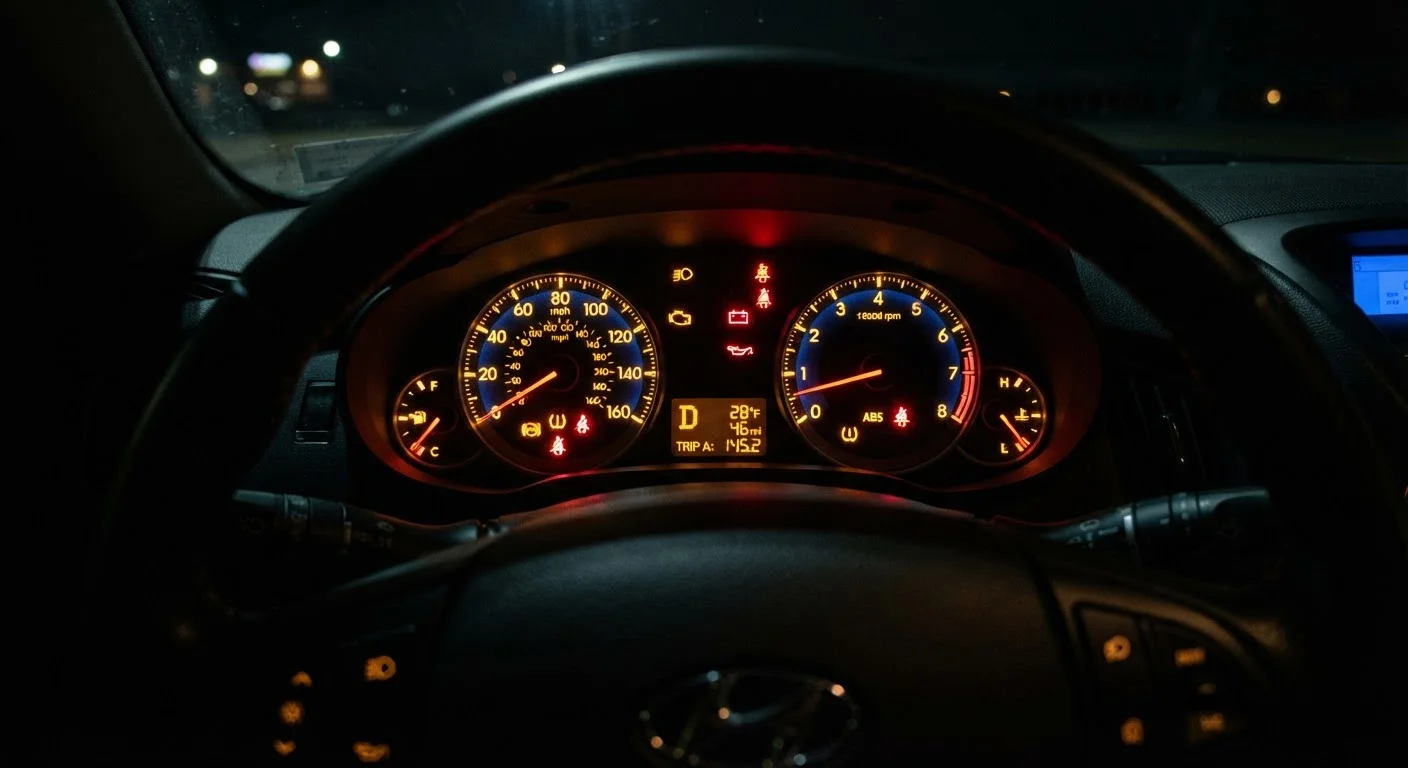
Photo: primesearches.net editorial
Tire pressure: the number on the door jamb versus the tire sidewall
Most drivers have seen two different PSI (pounds per square inch) numbers and assumed one is correct. The number molded into the tire sidewall is the maximum pressure that tire can safely hold. The number on the sticker inside your driver-side door jamb is the pressure your vehicle manufacturer recommends for ride comfort, handling, and fuel economy. Always use the door jamb figure.
Recommended cold tire pressure typically falls between 30 and 35 PSI for passenger cars. Tires lose roughly 1 PSI for every 10-degree Fahrenheit drop in outside temperature, which is why the TPMS (Tire Pressure Monitoring System) light appears on cold mornings. Check pressure when the car has been sitting for at least three hours; driving heats the air inside the tire and gives a falsely high reading.
Running 6 PSI below the recommended level can reduce fuel economy by roughly 3 percent, according to the U.S. Department of Energy. It also accelerates wear on the tire's outer edges. Overinflation wears the center tread faster and reduces the tire's contact patch, which shortens stopping distance on wet pavement.
For a broader look at how small oversights like this add up, see why deferred maintenance inflates monthly car costs.
PSI (pounds per square inch)
The unit used to measure air pressure inside a tire. Recommended PSI for your vehicle is listed on the door jamb sticker, not on the tire itself.
TPMS
Tire Pressure Monitoring System. A federal requirement on U.S. passenger vehicles since 2008 that triggers a dashboard warning when a tire is significantly underinflated.
Oil life monitor
An algorithm-based system that estimates remaining oil usefulness based on driving conditions. It does not measure oil level or directly test oil chemistry.
OBD-II fault code
A standardized diagnostic code stored by a vehicle's onboard computer when a sensor detects a problem. A scan tool reads these codes to help identify the source of a check engine light.
Alternator
A generator driven by the engine that recharges the battery while the car is running. A failing alternator causes battery and electrical warnings even when the battery itself is new.
Oil life monitors: what the percentage actually tracks
An oil life monitor does not measure the oil directly. It runs an algorithm that factors in engine temperature cycles, RPM patterns, idle time, and trip length to estimate how much useful life the oil has left. A reading of 40 percent means the system calculates that 40 percent of the oil's protective capacity remains, not that the oil is 40 percent full.
When the monitor reaches 0 percent or displays a warning, the oil has not necessarily turned to sludge, but the margin of safety is gone. Many manufacturers set their algorithms conservatively, so a 15 percent reading is a prompt to schedule service, not an emergency stop.
The old blanket rule of changing oil every 3,000 miles made sense for older engine technology. Most current vehicles with synthetic oil and modern engines have manufacturer-specified intervals of 5,000 to 10,000 miles or more. Following the monitor rather than an arbitrary mileage interval can save a family $100 or more per year without shortening engine life, provided the vehicle is not frequently towing or operating in extreme heat. Check your owner's manual to confirm what interval applies to your driving conditions.
If you want a full picture of what routine maintenance really costs over time, the true cost of car ownership covers how oil changes and other recurring expenses stack up.
Common dashboard warning lights decoded
Color is the first signal: red means stop or act immediately, yellow or amber means investigate soon, and green or blue is informational (high beams on, turn signal active).
- Low oil pressure (red oil can): pull over safely and shut the engine off. Driving with low oil pressure causes engine damage within minutes.
- Engine temperature (red thermometer): the engine is overheating. Stop driving, let it cool, and check coolant level only after the engine is cold.
- Check engine (amber engine outline): this can signal anything from a loose gas cap to a misfiring cylinder. A loose cap clears on its own after a few drive cycles. Any other cause needs a diagnostic scan, available free at many auto parts stores, to read the fault code.
- Battery (red battery symbol): the charging system is not maintaining voltage. The car may run for a short time on battery reserve alone. Have the alternator and battery tested promptly.
- TPMS (amber exclamation in a horseshoe): one or more tires are 25 percent or more below recommended pressure. Check all four tires with a gauge; the system does not always identify which tire is low.
For tasks you can address without a shop visit, routine maintenance you can safely do yourself explains where the practical limits are.
| Recommended tire pressure source | Driver-side door jamb sticker (Vehicle manufacturer specification) |
| Fuel economy loss from underinflation | About 3% per 6 PSI low (U.S. Department of Energy) |
| PSI drop per 10 degrees F temperature fall | Approximately 1 PSI (General engineering estimate) |
| TPMS required on U.S. vehicles since | 2008 model year (NHTSA federal mandate) |
| Typical synthetic oil change interval | 5,000 to 10,000 miles (Varies by manufacturer; check owner's manual) |
| Red warning light meaning | Stop or act immediately (ISO dashboard symbol color standard) |
The content provided on our blog site traverses numerous categories, offering readers valuable and practical information. Readers can use the editorial team’s research and data to gain more insights into their topics of interest. However, they are requested not to treat the articles as conclusive. The website team cannot be held responsible for differences in data or inaccuracies found across other platforms. Please also note that the site might also miss out on various schemes and offers available that the readers may find more beneficial than the ones we cover.