
Buying Used vs. Buying New: The Real Financial Trade-offs

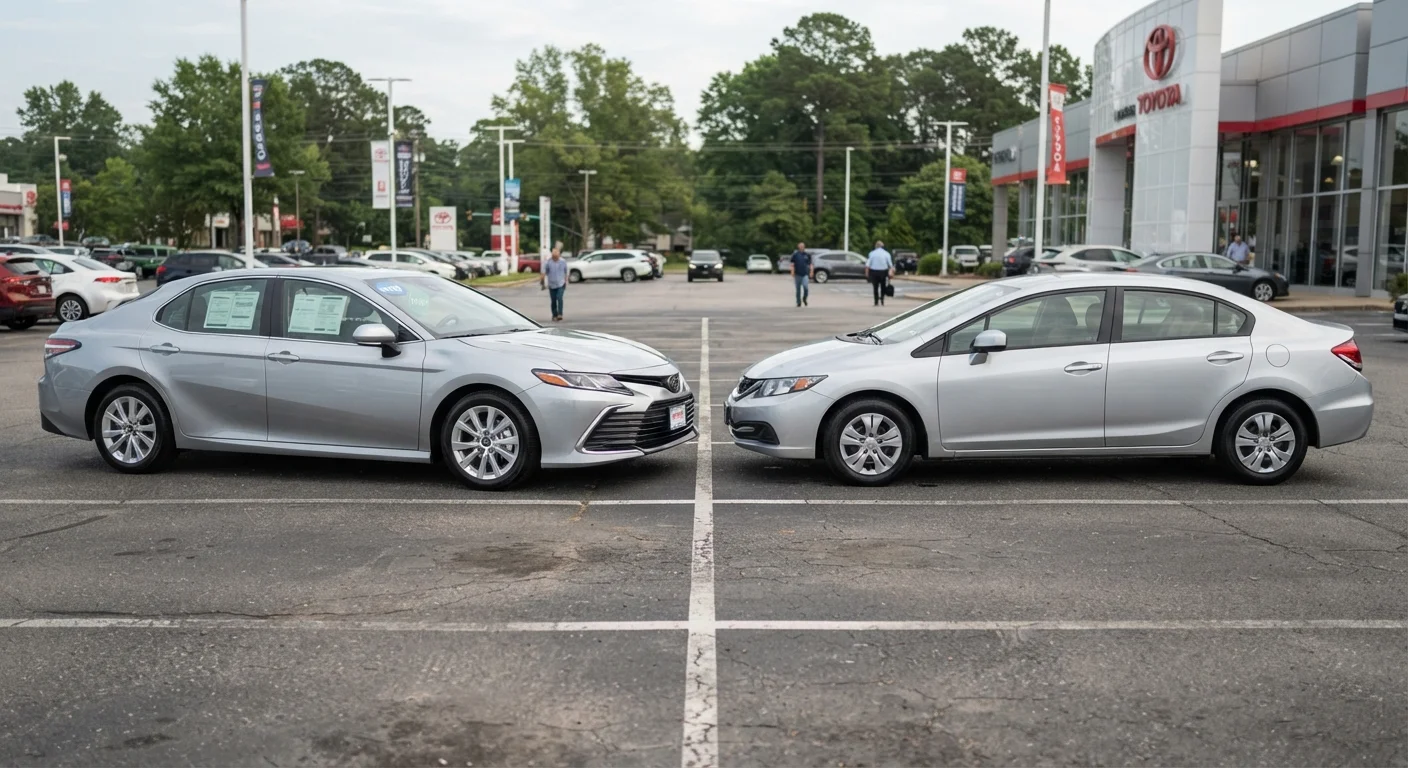
Photo: primesearches.net editorial
Key Takeaways
- New cars depreciate roughly 20% in the first year, which used buyers avoid entirely.
- New vehicles carry full manufacturer warranties; used cars may have limited or no coverage remaining.
- Financing rates on new cars are often lower, but the higher loan balance can erase that advantage.
- Insurance premiums tend to be higher on new vehicles due to replacement cost.
- Certified pre-owned programs offer a middle path with inspection standards and limited warranty coverage.
- Total five-year ownership cost matters more than the monthly payment alone.
How depreciation shapes the real cost gap
Depreciation is the single largest cost of vehicle ownership for most families, and it hits hardest in the first few years. A new car typically loses around 15% to 20% of its value in year one alone. By the end of year three, total depreciation can reach 40% to 50% of the original purchase price, depending on the model.
When you buy used, a previous owner absorbs that steepest part of the decline. A three-year-old vehicle that originally sold for $35,000 might be available for $20,000 to $22,000, and its remaining depreciation curve is much flatter. That gap is real money kept in your household budget.
For families comparing total five-year ownership costs rather than just sticker prices, this math often favors used vehicles substantially. Understanding the full ownership cost including depreciation, insurance, fuel, and maintenance, gives a more accurate picture than the monthly payment alone.
| Criterion | Buying new | Buying used |
|---|---|---|
| Purchase price | Full retail, higher upfront | Lower, varies by age and condition |
| Depreciation exposure | Absorb year-one drop (15-20%) | Steepest drop already absorbed |
| Manufacturer warranty | Full coverage from day one | Partial, limited, or none |
| Financing interest rate | Often lower, promotional rates available | Typically higher from lenders |
| Insurance premium | Higher due to replacement cost | Lower, more coverage flexibility |
| Vehicle history | None, you start it | Requires verification |
| Safety technology | Latest available features | Depends on model year |
Warranties, reliability, and the repair cost question
New vehicles come with a manufacturer's bumper-to-bumper warranty, typically three years or 36,000 miles, plus a powertrain warranty that often extends to five years or 60,000 miles. During that window, most mechanical failures cost you nothing beyond the deductible, if any.
Used vehicles may have some factory warranty remaining, especially if they are two or three years old. A certified pre-owned (CPO) vehicle goes through a manufacturer-defined inspection and receives a limited extended warranty, which narrows the reliability gap considerably. However, CPO pricing reflects that benefit, so the savings over new are smaller than with a standard used purchase.
A non-CPO used vehicle with 60,000 or more miles carries real repair risk. Setting aside a dedicated emergency repair fund of $1,000 to $2,000 before buying used is a practical step. Without that cushion, an unexpected transmission or HVAC repair can disrupt a tight family budget quickly. Practical guidance on managing car costs covers maintenance schedules and repair budgeting in more detail.
20%
Average new car value lost in year one
Industry data consistently shows new vehicles lose 15% to 20% of their value within the first 12 months of ownership.
$100-$150
Typical cost of a pre-purchase inspection
An independent mechanic inspection before buying a used vehicle is a standard recommendation from consumer automotive organizations.
3 years / 36k miles
Common new car bumper-to-bumper warranty
Most major manufacturers offer at least a 3-year/36,000-mile bumper-to-bumper warranty as a baseline on new vehicles sold in the US.
Financing rates and insurance costs
Lenders and manufacturers often offer lower interest rates on new vehicles than on used ones. Manufacturer-sponsored financing promotions can drop rates significantly below what a bank or credit union charges for a used car loan. However, a lower rate applied to a $35,000 loan can still produce a higher monthly payment and more total interest than a higher rate on a $20,000 loan.
Insurance is the other side of this equation. Collision and comprehensive coverage, which lenders require on financed vehicles, costs more on a new car because the replacement value is higher. On an older used vehicle, some families choose to carry liability-only coverage once the vehicle is paid off, which reduces the monthly insurance outlay meaningfully. Before adjusting coverage levels, reviewing your state's minimum requirements and your own risk tolerance is worth the time.
The combination of loan balance and insurance premium determines the true monthly cash commitment, not the interest rate alone. Running both numbers side by side for specific vehicles gives a clearer comparison than any rule of thumb.
Making the call for your family's situation
Several practical factors shape which path makes more financial sense. Annual mileage matters: if you drive 20,000 miles a year, you add wear faster than most used vehicles' histories assume, and new car depreciation accelerates proportionally. How long you plan to keep the vehicle matters too. Families who replace cars every four years get less return from a new purchase than those who hold for eight or ten years.
Your available cash for a down payment and your emergency fund balance both affect the risk calculation. A used vehicle bought with a 20% down payment and a solid repair fund is a lower financial risk than a new vehicle financed with 5% down, even if the new car carries a warranty. The warranty does not cover your cash flow if the payment is uncomfortably high each month.
Vehicle history, for used purchases, is not optional information. A full service history and a pre-purchase inspection by an independent mechanic, typically $100 to $150, can identify problems before they become your problems. That cost is a reasonable line item in any used car budget.
This article provides general financial information for educational purposes and does not constitute personalized financial or purchase advice. Consult a qualified financial professional for guidance specific to your circumstances.
The content provided on our blog site traverses numerous categories, offering readers valuable and practical information. Readers can use the editorial team’s research and data to gain more insights into their topics of interest. However, they are requested not to treat the articles as conclusive. The website team cannot be held responsible for differences in data or inaccuracies found across other platforms. Please also note that the site might also miss out on various schemes and offers available that the readers may find more beneficial than the ones we cover.