
Sod vs. Seeding: Which Lawn Approach Actually Makes Sense for Your Yard

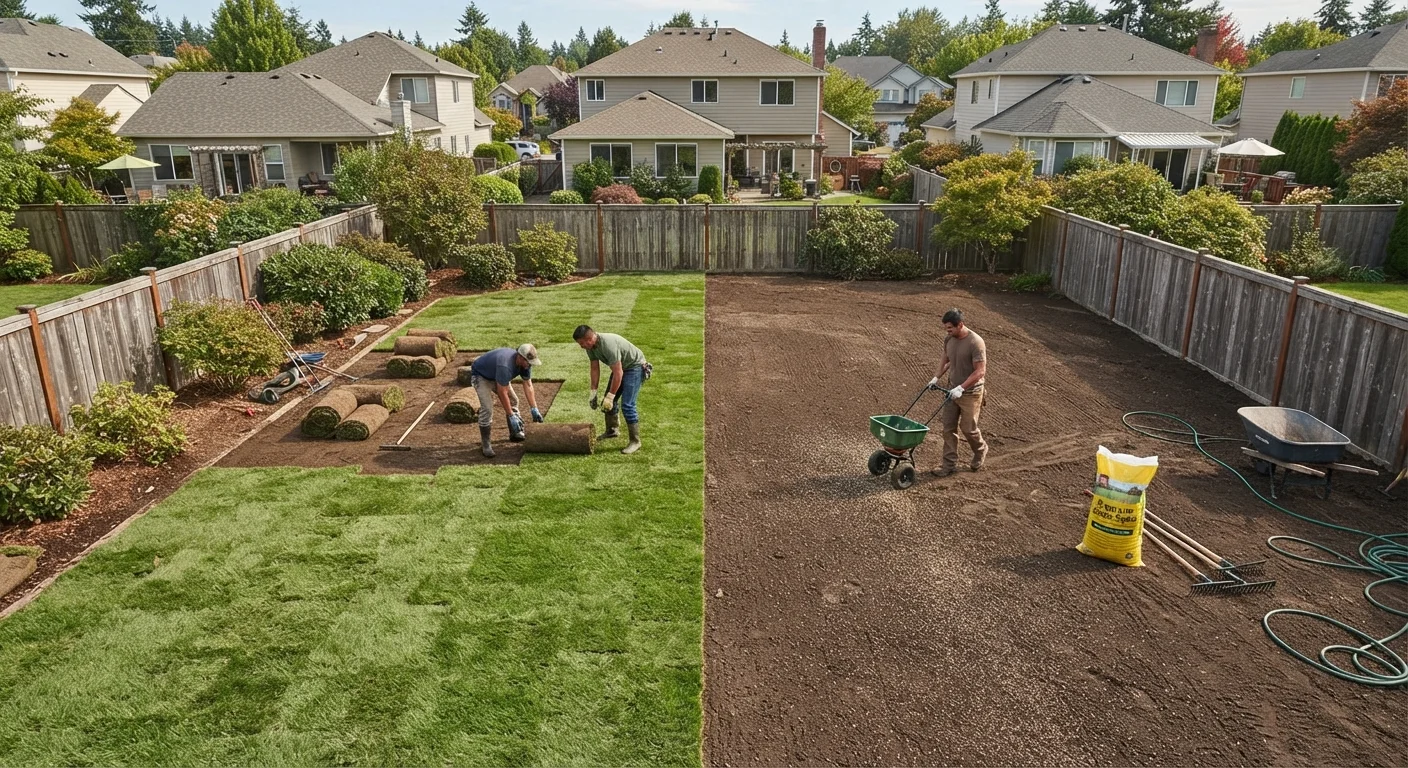
Photo: primesearches.net editorial
Key Takeaways
- Sod costs significantly more upfront than seed but produces a usable lawn within weeks.
- Seeding suits large areas where sod installation costs would become prohibitive.
- Soil preparation matters equally for both methods; skipping it leads to poor results either way.
- Cool-season grasses seeded in fall establish more reliably than those seeded in spring.
- Sod carries a higher transplant-failure risk during hot, dry summers without consistent irrigation.
- Local climate and grass species availability should shape your choice as much as cost does.
What you are actually deciding
Choosing between sod and seeding is mostly a question of what you are willing to trade. Sod trades money for time. Seed trades time for money. Neither is wrong, but the wrong choice for your specific yard will cost you more in the end, either in dollars spent or in a lawn that never quite establishes.
Both methods start with the same requirement: properly prepared soil. Tilling to a depth of four to six inches, correcting pH if needed, and adding compost where the soil is compacted or sandy applies equally to sod and seed. Skipping soil prep is the most common reason either approach fails.
If you are also planning a raised bed in another corner of your yard, the soil amendment work overlaps. See our guide to raised bed gardening for how to approach filling and amending on a budget.
Cost comparison
Sod typically runs between $0.35 and $0.85 per square foot for the material alone, before installation labor or delivery fees. A 1,000-square-foot lawn can cost $350 to $850 just in sod, and professional installation can double that figure. Seed costs far less: most grass seed runs $0.05 to $0.20 per square foot, depending on species. On a 1,000-square-foot area, that is roughly $50 to $200 in seed, plus any starter fertilizer and straw mulch.
The gap narrows on very small areas where sod installation is straightforward and labor time is minimal. On areas larger than 2,000 square feet, the cost difference becomes hard to ignore for families watching their home improvement budget closely.
| Criterion | Sod | Seeding |
|---|---|---|
| Material cost per sq ft | $0.35 to $0.85 | $0.05 to $0.20 |
| Time to usable lawn | 2 to 6 weeks | 8 to 16 weeks |
| Grass variety selection | Limited to local sod farms | Wide variety available |
| Erosion control | Immediate | Weeks to months |
| DIY difficulty | Moderate (heavy lifting) | Low to moderate |
| First-season watering demand | High (twice daily early on) | High (frequent light watering) |
| Best planting season | Spring or early fall | Late summer to early fall |
One cost that homeowners sometimes overlook with seeding is time-to-use. During the six-to-twelve weeks a seeded lawn needs to mature, the area often stays fenced off. If you are replacing a lawn before a planned event or before winter, that delay carries its own practical cost.
Timeline and establishment
Sod laid on well-prepared soil typically roots within two to four weeks. You can mow it lightly at three to four weeks and use it normally at six weeks. The visual payoff is immediate, which matters if curb appeal or a backyard event is driving the project.
Seeded lawns take longer at every stage. Germination alone runs seven to twenty-one days depending on species and soil temperature. Cool-season grasses like tall fescue and Kentucky bluegrass germinate best when soil temperatures stay between 50 and 65 degrees Fahrenheit, making late summer and early fall the most reliable seeding window in most of the country. Warm-season grasses like bermudagrass and zoysia prefer soil temperatures above 65 degrees, favoring late spring in the South.
Seeded lawns also face more competition from weeds during establishment. Pre-emergent herbicides cannot be used when seed is germinating, so weed pressure during those first weeks requires manual removal or tolerance until the turf fills in.
Maintenance in the first season
Both sod and new seed need consistent watering in their first weeks. Sod dries out faster than seed because the roots have not yet penetrated the native soil, so twice-daily watering for the first ten days is standard in warm weather. Seed needs the top inch of soil kept moist through germination, which usually means light watering once or twice daily.
After establishment, maintenance demands converge. Both need fertilizing, mowing at the appropriate height for the grass species, and irrigation during dry spells. The first-season difference is mostly in how unforgiving each method is if you miss a watering during heat: sod can die back in patches, while seed can simply fail to germinate in those areas and require reseeding.
10x
Typical cost difference: sod vs. seed per sq ft
General contractor and extension service estimates place seed material costs at roughly one-tenth the per-square-foot price of sod.
50-65°F
Ideal soil temperature for cool-season seed germination
University cooperative extension programs consistently cite this soil temperature range as optimal for germinating fescue, bluegrass, and ryegrass.
2 to 4 weeks
Average sod rooting time under normal conditions
Rooting time varies with soil contact, moisture, and temperature; hot or dry conditions extend this window considerably.
When each method makes the most sense
Sod makes practical sense when the area is small (under 500 square feet), when erosion is a risk on a sloped site, or when the timeline is fixed. It also works well for high-traffic areas like play zones where you need durable turf quickly.
Seeding makes sense for large flat areas where the cost of sod would be substantial, for homeowners who want a grass variety not available locally as sod, or for late-season overseeding projects. It also suits homeowners who are comfortable with a longer wait and can manage the watering schedule through germination.
One middle-ground option is hydroseeding, where a slurry of seed, mulch, and fertilizer is sprayed onto prepared soil. It costs more than hand-seeding but less than sod, and the mulch layer helps retain moisture during germination. It is typically done by contractors rather than as a DIY project, but it is worth pricing if you are on a mid-range budget with a medium-sized area.
The content provided on our blog site traverses numerous categories, offering readers valuable and practical information. Readers can use the editorial team’s research and data to gain more insights into their topics of interest. However, they are requested not to treat the articles as conclusive. The website team cannot be held responsible for differences in data or inaccuracies found across other platforms. Please also note that the site might also miss out on various schemes and offers available that the readers may find more beneficial than the ones we cover.